

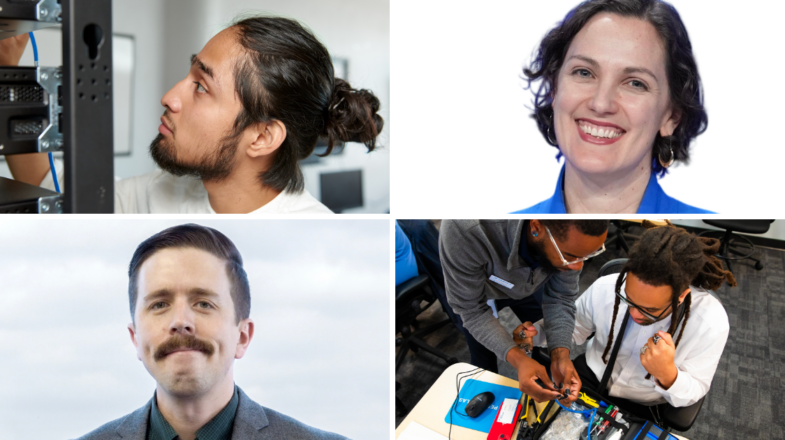
As technology reshapes nearly every sector of our economy, our nation’s public workforce development systems have struggled to keep pace. Per Scholas, one of the nation’s leading evidence-based sectoral job training providers, demonstrates how a responsive, partnership-centered approach can drive strong outcomes for learners – and how public policy could accelerate the development, refinement, and expansion of high-impact programs around the nation.
To date, Per Scholas has provided more than 30,000 learners with ’ no-cost technical training to launch successful careers. Per Scholas empowers learners with rigorous technology and AI training and industry-recognized credentials to pursue tech careers, and connects skilled talent to leading businesses across industries. Their impact is well-demonstrated: multiple randomized controlled trials have shown Per Scholas drives enduring employment and earnings growth among participants.
Per Scholas is committed to an agile, data-driven model that involves continuous adaptation and improvement. For example, Per Scholas has taken many steps to adapt its model to the modern AI era by integrating AI literacy and applied AI skills across its training programs in order to prepare learners to responsibly use AI tools, adapt to evolving workplace demands, and succeed in an AI-enabled economy rather than be displaced by it. Per Scholas has also leveraged AI to support its instructors by reducing administrative burdens and providing immediate, personalized feedback to learners. A more effective, efficient workforce system that prioritizes high-impact, agile strategies could help programs like Per Scholas serve many more learners around the nation – including both urban and rural communities. As Congress continues to consider reauthorization of the Workforce Innovation and Opportunity Act (WIOA) and other policy vehicles, Per Scholas offers a critical perspective.
Per Scholas is a member of the America Forward Coalition, a collective advocacy network of over 100 of our nation’s most impactful and innovative non-governmental organizations. America Forward recently spoke with Caitlyn Brazill, Per Scholas President, and Dillon Moore, Per Scholas Director of Government Affairs & Policy, on the key aspects of Per Scholas’ proven model and how government can enable more responsive, effective workforce development.
Per Scholas is one of the leading examples of a sectoral training program, and your evidence of impact is incredible. What distinguishes Per Scholas’ model and value-add from your perspective?
Caitlyn Brazill: First, the key thing is that sectoral alignment is not a static framework. It’s an adaptive system that we are trying to keep pace with rapid technological change, including AI, across all sectors for which we are providing talent. And so, Per Scholas’ model has been developed with that principle in mind: agile, evidence-driven, deeply connected, both to employers and job seekers.
There are a few specific things that distinguish the Per Scholas model. Certainly, at this point, our national scope: we are operating in 25 different U.S. markets. We are training 6,000 adults a year in our immersive model, and an additional 3,000 in our career accelerator. We today are partnering with more than 1,000 different employers nationwide, some of whom we are co-designing curriculum, and all of whom we are regularly collecting insights about their labor market demand, their perspectives on their own hiring patterns, and feedback on our curriculum, on the talent that we’ve been able to help them connect to.
We’re also distinguished by the evidence base we’ve developed over time: that our intervention has long-term, sustained impacts on wages, the likelihood of working in technology roles, and life satisfaction. Historically, our learners have an 85 percent graduation rate, 80 percent job attainment, and on average, earn three times their pre-training wage in their first job after Per Scholas.
We continue to be really committed to data-driven improvement to make sure we are on track to reach those critical outcomes. We are looking at the efficacy of our work at many, many points in time, long before we get to the measure of job attainment and economic mobility. Are we able to attract and recruit the learners that we seek to bring into our programs? How are our learners accessing the wraparound supports that we provide? Are we seeing the kind of educational progression that we want to see in the classroom? Are our curricula aligned to both employer needs and reaching the knowledge-based assessments and certifications that we expect learners to earn to by the end of the course?
Per Scholas had been very intentional in its partnerships. What does this look like in practice?
Caitlyn Brazill: We’ve been able to thrive over time by focusing on the set of work that we are really good at. We are good at building curricula that respond to employer needs, at teaching through this incredibly immersive model, and at integrating technical and professional development skills. And we are great at coaching and supporting people through their job search. We pursue partners for the other wraparound supports that people really need to thrive when they are committing to a 3- or 4-month training track, and then launching a new career.
This work looks different in different places. For example, we’ve been able to successfully launch training in rural communities through partnership models. There are two key pieces to that equation: One are employers who are invested in that community, and sufficiently proximate for people to realistically go to work. The other thing that’s really important about taking a model that was born in urban environments and testing it in rural communities is just recognizing that the scale is going to be different. We’ve generally run smaller class sizes in rural communities. We’re really careful to ensure that we’re balancing the sheer number of people that we’re training with the available job opportunities, because we don’t want to oversaturate a community with the same skill sets. Also, we have a number of different models for our training. The satellite model, in which an instructor teaches a classroom at another location with full audio and visual, has proven really useful in rural communities because it allows for us to offer an in-person experience in a cost-efficient manner.
I would also note that in rural communities in particular, we’ve increasingly partnered with companies that are owners, operators, or major customers of data centers. We recognize that while data centers are critical digital infrastructure, they can place pressure on local energy and water resources, which is why our focus is on preparing a skilled local workforce so that communities experience real economic benefits while infrastructure growth advances alongside responsible, sustainable resource use. For example, three years ago we partnered with TEKsystems to develop a data center training track to support ongoing operations. TEKsystems has been an incredible partner – we’ve achieved about nearly 1,500 job attainments with them over the past decade. And we are in conversations now with a number of data center providers to help support them in making that investment in local communities and providing that skilling so that they’re not importing talent into rural communities, but in fact, are helping to create economic mobility pathways for the people who are already there.
What does the Per Scholas experience look like from a learner’s perspective?
Caitlyn Brazill: Considering the workforce development system writ large, very few people have linear career pathways. There are very few 17-year-olds who can tell you what they’re going to do in life, and for whom by the time they’re 35, they have followed that direct path to doing it. And so, the value, I think, to Per Scholas is developing deep relationships in a variety of sectors that are tech-dependent, so we can help people figure out the pathway that they are looking for.
For example, one of our alums, Carter Guin, came to Per Scholas because he had found us at a job fair. He had already completed college and was actually working as a preacher. But he knew that there was no growth potential in his career path, recognized that the economy was changing fast, and didn’t feel like he had a skill set that was marketable in the private sector. We had launched a satellite campus in Covington, Kentucky, in partnership with the Kentucky Career Center, and Carter was able to gain access to high-quality training and didn’t need to relocate or take on debt. Within a few months of completing that training, he landed a full-time role as an on-site support engineer.
Carter now supports multiple hospitals in the Cincinnati area. When you think about a sectoral approach, sometimes you think of employers only in a given sector, right? But really, for Per Scholas, it is a matter of thinking about occupation groups and developing relationships across employer sectors in order to help people follow those pathways. He went on to earn his MBA in IT management, he’s now pursuing his CCNA through our Career Accelerator course, he’s advancing along his tech career pathway, and he’s in fact contributing to the health sector, as opposed to the technology one.
One of Per Scholas’ hallmarks is your adaptation to the changing labor market and partnerships with employers, including major trends like AI. But workforce policy frameworks have been much slower to change and adapt, and have underinvested in evidence-based models like Per Scholas. How do you assess the current landscape?
Caitlyn Brazill: Public funding has been roughly 10% of our overall revenue picture. That is typically coming to us from local workforce boards, local governments, or state governments, and is usually a mix of funding streams originating from the federal government. In almost every case, these are small grants that are highly locally targeted and do not roll up to an important source of revenue for Per Scholas.
Very rarely – and in fact, I can’t even come up with an example of it– do these public grants actually cover the full cost of program delivery. Most importantly, only very rarely are these grants designed to fund cohort-based, demand-driven training aligned with our typical approach. So often, we’re fitting a square peg into a round hole of local governments, figuring out how to use Individual Training Account vouchers under WIOA, or reimbursement mechanisms that fund one person at a time.
And it’s become extremely apparent that there are material differences between jurisdictions and how they adapt their licensing regimes to respond to a changing market. Over the last year and a half, we have had multiple, complete overhauls of every single training track we offer to integrate AI into our work and then do that again and again. We know that is going to continue to happen as tools evolve and workforce expectations change, so as an organization we made investments in our teams and analytical capacity to make sure we can keep pace.
But I can tell you we now see a real difference between those markets that have slow and stringent licensing requirements, and require us to get new approvals at a state level on new curriculum, and those that don’t. In states that don’t have the same requirements, we get new content out 6 to 9 months earlier – and at this moment, that’s a material difference.
With that in mind, what should policymakers prioritize as they look to restructure public funding structures moving forward?
Dillon Moore: All of these points underscore the need for new, modern workforce development legislation. Congress came close to reauthorizing WIOA back in December 2024, and I think that there’s opportunity there to build on bipartisan momentum from back then to get a reauthorized version of the law across the finish line.
We believe Congress should prioritize skills training under WIOA. That could include setting thresholds for the amount of funding that needs to be dedicated towards in-demand occupational skills training and high-performing occupational training programs that work.
Also, as Caitlyn discussed, the labor market and the economy looks very different in 2026 than it did back in 2014, when WIOA passed. Congress should prioritize system agility to increase flexibility for training programs to be responsive. Providers need the flexibility to adapt curriculum quickly, to match in-demand skill sets and credentials that employers are looking for and looking to hire for.
This could mean reducing some of the administrative obstacles for training providers to partner with the workforce system, such as easing the administrative requirements that come along with things like the state eligible training provider list (ETPL), which governs access to WIOA funding. Often ETPLs present very different experiences, depending on which state you’re working with. It could also include increasing flexibility for states and local workforce areas to contract more directly with high-performing evidence-based programs.
And the last thing that I’d mention would be emphasizing the customer experience, which could include things like streamlining the enrollment experience for individuals looking to get connected to our programming, or easing the administrative burden that often comes for businesses and other organizations looking to partner with the workforce system.
Building on those recommendations, are there some bright spots you’ve seen in federal policy?
Caitlyn Brazill: When you have effective models that can move to meet demand, if you have resources, you can follow that demand. To offer a solution in a community, we have to work through all of the different layers for government investment to offer a solution. That’s okay in a stable and slow-moving marketplace. But I will tell you, if you’re really trying to respond to employer demand, it’s pretty rare that that process can align from a timing perspective to when an employer has made firm decisions and is ready to implement a talent pipeline.
Dillon Moore: We’ve seen some promising things at the federal level. The administration released their America’s Talent Strategy report that had some forward-thinking strategies and goals when it comes to rethinking the federal workforce development system. Many elements were in alignment with the work we’re already doing at Per Scholas, around things like industry-driven strategies, improving worker mobility, and emphasis on performance and accountability.
I would also add that late last year, the Department of Labor released new guidance around WIOA encouraging states and local workforce areas to embrace flexibility under the law. [NOTE: See America Forward’s statement on the guidance here.] The guidance had examples of policy waivers that states could pursue to enhance program flexibility. That’s all in alignment with that point about the need for system agility, particularly in a time where we’re really experiencing fast-paced changes to skills in demand amongst employers and industries.
Beyond WIOA, we’re also considering opportunities around Workforce Pell, which passed last year and expands federal Pell Grant eligibility to short-term training programs. We would encourage Congress and the implementing agencies to consider frameworks that would allow high-performing, evidence-based non-institutional training organizations to partner more fully with higher education.
Is there anything else that policymakers should consider at this particular moment in time?
Caitlyn Brazill: We have seen growing interest overall in apprenticeships, and some good momentum at the state level in providing clarity and funding on an ongoing basis that employers could actually predict.
The piece that I would really want to underscore is that there is a very considerable reduction in entry-level hiring over the last 3 years, particularly the high-cost markets where we operate. In New York, where I am based, we’re talking about a 30 percent reduction in entry-level new hire openings, and about 50 percent in technology roles.
This is a substantive shift in availability of entry-level opportunities. It’s not one that I think is permanent. I think that we are in an adjustment period. But it does require a new approach around how to subsidize and appropriately create incentives for employers to bring on entry-level talent. In many cases there’s a real interest in bringing on mid-career folks. People with 5 to 10 years of experience in a lot of different fields are incredibly attractive at this moment, because they can help you to develop the AI agents and do much of the work that needs to happen in finance, in accounting, in business operations. But over the long haul, you will need to grow earlier-career talent alongside that newly created community of agents.
So there is an important moment, nationally, for us to figure out how to create the right kinds of incentives that make it economically viable for companies that are competing in a global marketplace to have entry-level talent, and that need to be able to support themselves.
On that note, I want to leave you with one last example. For the past couple of years, we’ve had a partnership with an interesting double bottom line company called PeopleShores (a double bottom line company is a for-profit business that measures success by both financial profitability and positive social or environmental impact). Their model is to convince Fortune 500 companies to take some piece of their outsourcing spend and dedicate it to domestic delivery centers. We got to know them in partnership with Morgan Stanley, and have developed our involvement in their partnership with Accenture.
PeopleShores runs an apprenticeship program for Accenture and initially hires team members as PeopleShores employees, while Per Scholas provides full-time immersive training for apprentices on tracks including data engineering, full-stack software development, and cybersecurity. This approach helps de-risk the process for Accenture before they make full-time job offers, while apprentices get hands-on insight and learning pathways. Today, 85 percent of these apprentices have transitioned into full-time employment with apprenticeship with salaries from $70,000 to $100,000. This model is the kind of thing we could do at a much greater scale with dedicated public support.
Leave a Reply
You must be logged in to post a comment.