

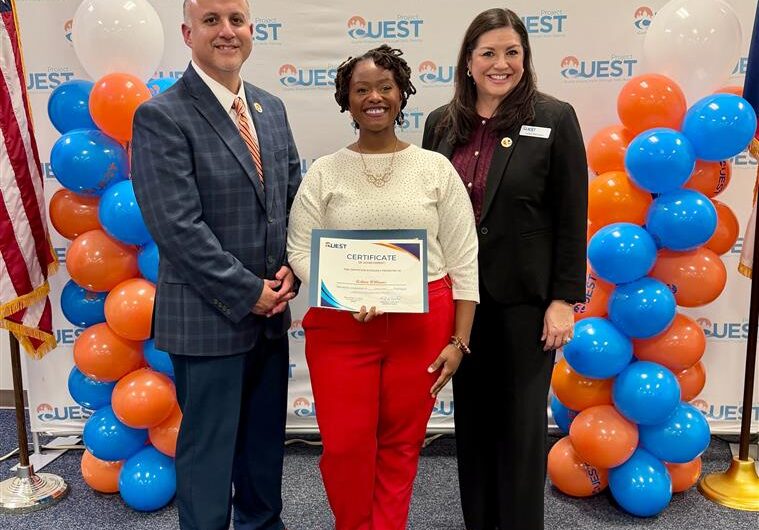
Photo: Francisco Martinez, President & CEO of Project QUEST, and Lelani Mercado, Chief Program Officer of Project QUEST with a December 2025 graduate.
Across the United States, communities are searching for workforce solutions that deliver real, lasting economic mobility, not just short-term job placements. In San Antonio, Texas, one model has been proving what works for more than three decades: Project QUEST.
Founded in 1992 by working class families alongside local government and business leaders and led by Communities Organized for Public Service and Metro Alliance, Project QUEST was created in response to the disappearance of manufacturing jobs and the growing disconnect between local workers and emerging industries. Project QUEST pioneered a comprehensive sector-based model that aligns training with employer demand while providing wrap-around services to participants.
Today, with persistence and completion rates of approximately 80 percent and more than 10,000 graduates, Project QUEST stands as one of the most rigorously evaluated workforce programs in the nation. A long-term randomized controlled trial found that Project QUEST participants achieved sustained annual earnings gains of 15 to 20 percent over 14 years, providing compelling evidence that well-designed workforce investments can permanently change economic trajectories.
Moving forward, workforce development programs nationwide could significantly improve outcomes for individuals facing employment barriers by adopting Project QUEST’s proven model. Project QUEST’s success has already inspired broader adoption of core elements of its model, most notably through San Antonio’s Ready to Work initiative and a recent Colorado initiative inspired by QUEST’s approach. The San Antonio Ready to Work initiative garnered 77 percent voter approval in 2020, pioneering local government financing to scale a proven model with dedicated sales tax funding. As cities across America grapple with workforce challenges and economic inequality, Project QUEST offers a blueprint for transformation, one that has been rigorously tested and proven to change lives.
Project QUEST is a member of the America Forward Coalition, a collective advocacy network of over 100 of our nation’s most impactful and innovative non-governmental organizations. America Forward recently spoke with Francisco Martinez, Project QUEST’s President & CEO, on what it takes to scale a proven workforce model and the policy conditions that make it possible.
Project QUEST is widely recognized as one of the earliest and strongest examples of evidence-based sector-based workforce development in the country. What are the core elements of the Project QUEST model, and why do you think it has been so effective over time?
Francisco Martinez: One of the things I tell people before describing the model is that Project QUEST has a soul and a history. We were created specifically to address one problem and one problem only, which is connecting adults to occupational training and sector-specific credentials that lead to in-demand, high-paying careers with benefits and long-term mobility, not just jobs. At the time of our founding, many adults were enrolling in community colleges but not completing. The system was not designed for working adults with children, financial pressures, and competing responsibilities. We were created to strengthen that pathway, not replace it. Over time, we have partnered closely with community colleges to improve persistence, completion, and labor market outcomes for our shared students. When our participants succeed, the colleges succeed.
In San Antonio, one of the most economically segregated large cities in the country, that reality has shaped opportunity gaps for generations and continues to do so today. Our typical participants are 31 years old, often a parent or single parent living in poverty. In systems where individuals with this profile statistically struggle to complete, we operate with a “whatever it takes” philosophy.
Our model is grounded in a sector-based career coach approach, where the program pairs participants with dedicated career coaches, who connect them to academic support, wraparound services, trauma-informed care, and financial assistance, including tuition, childcare, housing, and emergency aid, to remove barriers to completion.
Our 33-year track record speaks for itself. We have built a reputation for developing participants who do more than show up; they excel, persist, and build lasting careers. As a result, employers now seek us out. Many tell us they’ve been hiring our graduates for years without realizing the connection, and once they discover the common thread, they want to formalize the partnership. In today’s competitive landscape, employers know that building these relationships early means securing a workforce that’s not only trained and ready, but proven to succeed.
From coaching to employer partnerships to post-employment advancement, we stay with participants beyond the first job placement, because that first job is not the end goal; it’s the beginning of a sustainable career pathway.
One hallmark of Project QUEST’s approach is its robust supportive services. Why are these supports so central to your model, and how are they integrated programmatically and not just philosophically?
Francisco Martinez: We know that life happens. The adults we serve are typically between 31 and 39 years old, often parents or single parents, and they face real barriers outside the classroom. We think about Maslow’s hierarchy of needs. Participants need stability for themselves and their families before they can focus on training and career advancement. Most of our participants are enrolled in community college programs aligned with high-demand sectors. Our role is to help them persist and complete in systems that were historically built for traditional-age students. By strengthening student stability, we help improve institutional outcomes as well.
Programmatically, our supportive services are built into the model. We act as both advocate and referral partner, connecting participants to public programs and nonprofit providers for childcare, healthcare, food assistance, and other supports. But we also know those systems are often underfunded and overwhelmed. When external resources fall short, we put skin in the game. We build flexible funding into our budget so we can provide direct assistance in emergencies, whether that means assisting with rent when our participants have to devote additional hours to clinical training, paying for required equipment, fixing a flat tire, or providing a laptop or Wi-Fi access.
There is no single definition of a barrier. It might be childcare, transportation, lack of professional attire, a background issue that requires expungement support, dental care that affects confidence, or interview preparation. Our coaches are empowered to identify and address whatever could derail persistence. The goal is simple: remove the obstacle before it becomes the reason someone drops out.
That is why supportive services are not philosophical for us. They are operational. They are built into our budget, our partnerships, our accounting systems, and our daily decision making.
Project QUEST has been thoughtful about expanding its model to serve more participants while maintaining quality and outcomes. What has your experience been with expansion, and what does it take to scale an evidence-based program with fidelity?
Francisco Martinez: Just as we did at our founding, when community leaders came together to respond to an urgent need,Project QUEST once again answered the call during the pandemic. What began in 1992 serving about 150 participants with a small staff has evolved over time to meet the moment. When I came on board, we were emerging from the public health crisis, having rapidly expanded from serving roughly 1,000 individuals annually to more than 2,000 in direct response to the pandemic’s economic impact. Today, Project QUEST serves approximately 2,600 individuals each year with a dedicated staff of 56, continuing our legacy of stepping forward when our community needs us most.
Scaling an evidence-based model takes discipline. Growth cannot come at the expense of quality. Because our work is transformative, not transactional, scaling requires maintaining depth of service, not just increasing volume. For us, scale has to mean maintaining the same level of service and outcomes at a larger reach. That requires staying disciplined about staffing to participant ratios, strengthening support services, and investing in the operational infrastructure that makes the model work, including finance, compliance, and data systems.
We have been intentional about remaining a hyper-focused San Antonio and Bexar County organization. While we share our lessons nationally and sit at tables across the country, our work is grounded locally. What works here may not translate everywhere, but the core principles of a sector-based model with strong wraparound support have proven effective in many places. We’ve seen our model duplicated across Texas and the U.S.
Ultimately, scaling with fidelity means knowing your limits. We are the largest we have ever been in terms of capacity and staff, and any additional growth will require new investments. Our daily focus is ensuring that serving 2,600 people feels no different in quality than when we were serving 150.
Public funding, particularly funding streams under the Workforce Innovation and Opportunity Act (WIOA), plays a critical role in workforce development, but funding structures don’t always align well with the most high-performing, evidence-based models. How has Project QUEST navigated WIOA, and what kinds of flexibility in implementation matter most?
Francisco Martinez: WIOA has the capacity to be very helpful, and it has been helpful to Project QUEST over the years. We have operated in that space before and are currently transitioning out of some WIOA funding. At its best, WIOA can support sector-based training and job preparation aligned with employer demand, which is critical for programs like ours.
That said, WIOA comes with its own requirements. The reporting and compliance structure is often more rigid and administratively burdensome than other funding sources. For high-performing, evidence-based models, the key question is alignment. The funding has to align with our focus on career pathways, long-term mobility, and measurable outcomes, not just short-term job placement metrics.
The flexibility that matters most is the ability to support sector-based strategies, invest in quality training, and partner with proven providers. When WIOA funding is aligned with performance and evidence, it can be a powerful tool. But it has to be the right fit for the model and the organization to ensure we are meeting both public accountability standards and our mission-driven goals.
As policymakers revisit WIOA reauthorization, what should they prioritize if they want to enable programs like Project QUEST to succeed and scale?
Francisco Martinez: If policymakers want programs like Project QUEST to succeed and scale under WIOA reauthorization, they need to prioritize stronger investment in training, not just job placement, and direct funding toward evidence-based, performance-based models.
WIOA has the capacity to support sector-based strategies that work. But the funding structure needs to reflect what it actually takes to move someone into a life-changing career. Our model is labor-intensive. It requires sustained career coaching, wraparound support services, and long-term engagement. Too often, sustained coaching and support services are categorized as administrative costs when in reality they are the engine of outcomes.
There also needs to be more flexibility and accessibility for nonprofits with proven outcomes, as well as emerging organizations demonstrating strong results. If WIOA intends to connect adults to workforce training that leads to family-sustaining careers, then policymakers should focus on the outcomes and allow local providers flexibility in how they achieve them.
I often think about it in terms of intent. If the goal is to connect people to life-changing careers, then let organizations show how they can do that effectively in their communities. What works in San Antonio may not look the same in a rural area, but if the outcomes are strong and the model is evidence-based, there should be room for innovation within the framework. When funding defines both the outcome and the exact method, it can limit the very effectiveness it is trying to promote.
Are there promising state or local policy approaches you’ve seen, in Texas or elsewhere, that policymakers should be paying closer attention to?
Francisco Martinez: In Texas, there have been some forward-thinking policy shifts. One important change has been tying community college funding more directly to job placement and high-demand careers. That creates incentives for institutions to focus on labor market outcomes.
We have also received state-aligned funding that supports efforts to improve persistence and completion rates at community colleges. It is not an either-or approach. We can work in conjunction with existing systems. Our success is the community college’s success. We are often serving the same students, but with a model designed for adults who may not thrive through traditional pathways. In that sense, we function as a student success partner to community colleges, helping improve persistence, completion, and post-training wage outcomes for our mutual participants.
At the local level, San Antonio Ready to Work is another promising approach. It is a voter approved, sales tax funded workforce initiative informed by core elements of the Project QUEST model. It operates at a citywide scale and brings together multiple partners to address generational economic challenges. It incorporates core components such as sector focus, strong support services, and alignment with employer demand.
What makes that model promising is coordination. Employers help define in-demand careers alongside the City’s Workforce Development Office and its Community Lead Advisory Board. Training providers align programs to those careers. Community-based organizations support participants. There is shared alignment around who is being served and what outcomes matter.
It also requires flexibility. Labor markets change. After the pandemic, demand for Commercial Driver’s Licenses (CDLs) was high, and participants could move quickly into those roles. Today, we are seeing similar shifts in sectors such as IT and manufacturing in response to economic trends. The key is having partners who review labor market data, adapt strategies, and make collective decisions.
When public funding supports proven models, aligns stakeholders, and allows flexibility to adjust to changing conditions, it can have a significant and sustained impact on a community.
Finally, if you could leave policymakers with one message about what it truly takes to support workers and employers in today’s economy, what would it be?
Francisco Martinez: Supporting workers and employers today takes innovation, flexibility, and adaptability.
As a nonprofit, we are able to pivot more quickly than traditional public systems. We can adjust to changes in the labor market, respond to employer needs, and refine our approach in real time. The distance between decision and implementation is shorter, which allows us to innovate and adapt faster.
That is where nonprofits can be especially valuable. We do not need to do everything, but in the areas where we operate, we can move quickly, test what works, and deliver strong results. When public systems create space for that kind of flexibility and partnership, nonprofits can complement traditional workforce systems and help ensure that public investments translate into durable economic mobility.
Leave a Reply
You must be logged in to post a comment.